Quick answer: A home battery costs about $15,647 installed for 13.5 kWh of storage in 2026, or roughly $1,159 per kWh on EnergySage’s marketplace, and buyers no longer get a federal tax credit. A Tesla Powerwall 3 runs about $15,000 installed with solar, Enphase’s 10 kWh IQ Battery 10C about $14,250, and FranklinWH’s 15 kWh aPower 2 about $17,250.
Last verified: October 16, 2026. Prices from EnergySage (battery cost guide updated July 13, 2026; battery-without-solar guide updated August 18, 2026; marketplace report updated October 7, 2026), Solar.com (installer price lists, September 2026) and SolarReviews (Tesla-direct quotes); specs from Tesla, Enphase and FranklinWH; tax credit status from the IRS; incentives from each program’s own page. Sources and dates in the methodology section.
What the main home batteries cost, installed
Battery prices are quoted three different ways: the battery alone, the battery installed on its own, and the battery added to a new solar system. The third is the cheapest per unit of storage, because the permit, the electrician’s visit and the inspection are shared with the solar job. Here is what two independent marketplaces report for the batteries installers quote most:
| Battery | Usable storage | Continuous power | Solar.com median, installed with solar (Sept 2026) | Middle 50% of installer prices | EnergySage brand average, H1 2026 |
|---|---|---|---|---|---|
| Tesla Powerwall 3 | 13.5 kWh | 11.5 kW | $15,000 | $13,950–$16,200 | $967/kWh |
| FranklinWH aPower 2 | 15 kWh | 10 kW | $17,250 | $14,700–$18,100 | $1,232/kWh |
| Enphase IQ Battery 10C | 10 kWh | 7.08 kW | $14,250 | $13,000–$15,600 | $1,429/kWh |
| Enphase IQ Battery 5P | 5 kWh | 3.84 kW | $10,650 | $9,250–$13,700 | $1,429/kWh |
Capacity and power are from each manufacturer’s own product page. EnergySage publishes one average per brand, not per model, so the Enphase figure covers both of its batteries. Across all brands, EnergySage’s battery guide puts the typical installed cost at $15,647 for 13.5 kWh, or $1,159 per kWh, before incentives. Its first-half 2026 marketplace report gives $1,130 per kWh. EnergySage doesn’t explain the gap between its two figures, but both put a single full-size battery at about $15,000 to $16,000 installed.
Solar.com notes that it is a Tesla Certified Installer. Its figures are installer price lists rather than signed contracts, which is why we show them next to EnergySage’s quote data rather than alone.
Warranties differ more than prices. Tesla covers the Powerwall 3 for 10 years. Enphase covers both IQ batteries for 15 years or 6,000 cycles, and FranklinWH covers the aPower 2 for 15 years or 60 MWh of throughput.
How much does home battery storage cost per kWh?
About $1,159 per kWh installed across all brands (EnergySage’s battery guide), or $1,130 per kWh in its first-half 2026 marketplace report. That’s the number to compare, because the sticker price rewards small batteries. Brand averages on EnergySage run from about $342 per kWh (MidNite Solar) to $3,505 (Fortress Power), and state averages from $563 in Alabama to $1,586 in Louisiana.
Divide each popular model’s installed price by what it stores and the order flips:
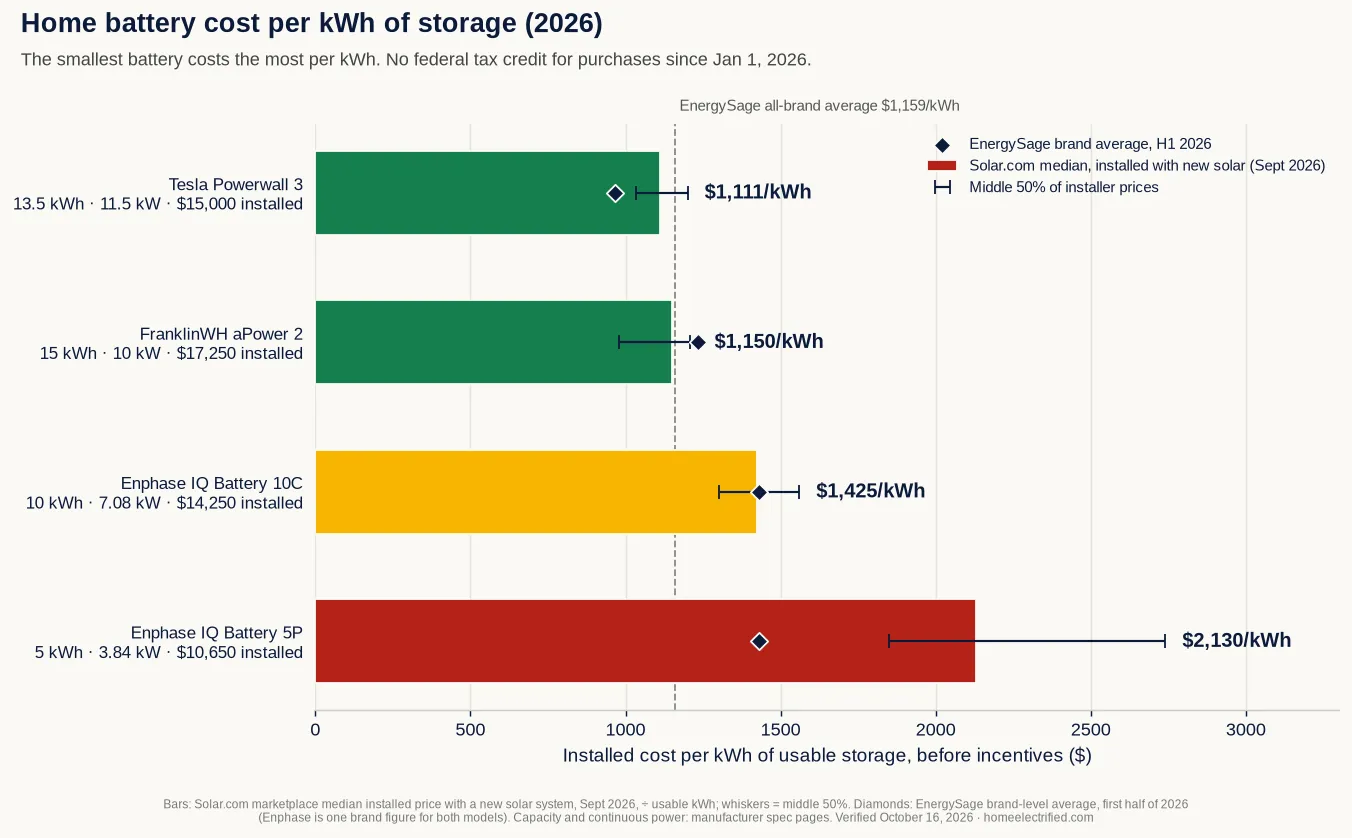
| Battery | Installed (Solar.com median) | Per kWh of storage | Per kW of continuous power |
|---|---|---|---|
| Tesla Powerwall 3 | $15,000 | $1,111 | $1,304 |
| FranklinWH aPower 2 | $17,250 | $1,150 | $1,725 |
| Enphase IQ Battery 10C | $14,250 | $1,425 | $2,013 |
| Enphase IQ Battery 5P | $10,650 | $2,130 | $2,773 |
The math is plain division. For the Powerwall 3: $15,000 ÷ 13.5 kWh = $1,111 per kWh, and $15,000 ÷ 11.5 kW = $1,304 per kW. For the IQ Battery 5P: $10,650 ÷ 5 kWh = $2,130 per kWh.
The second column matters for backup. Storage (kWh) decides how long the battery lasts. Power (kW) decides what it can run at once. The Powerwall 3 is the cheapest per kWh and per kW here, which is most of the reason it dominates quotes. The IQ Battery 5P is the cheapest way in, but it buys you the least of both. That makes sense for evening bill savings and little else.
Solar.com also lists a consumption-only IQ Battery 5P, with no backup hardware, at a median of about $6,125. If you only want the battery for bill savings, skipping backup is the biggest single saving on the list. It also means the battery can’t keep your lights on in an outage.
How much does a 10 kWh battery cost?
About $11,300 to $14,300 installed, depending on whether you go by the all-brand average or by the 10 kWh model most installers actually quote:
| 10 kWh, priced from | Installed, before incentives |
|---|---|
| EnergySage all-brand average, H1 2026 report ($1,130/kWh × 10) | $11,300 |
| EnergySage battery guide average ($1,159/kWh × 10) | $11,590 |
| Enphase IQ Battery 10C, Solar.com median with new solar (Sept 2026) | $14,250 |
| Enphase brand average on EnergySage ($1,429/kWh × 10 kWh) | $14,290 |
The averages are lower because they mix in cheaper-per-kWh brands and bigger batteries, which spread the fixed cost of installation over more storage. A Powerwall 3 stores 35% more than a 10 kWh battery ($15,000 median) for only about $750 more than an IQ Battery 10C.
Searches for a “10 kW battery” usually mean 10 kWh. The two are different: kWh is how much the battery stores, kW is how much it can deliver at once. The IQ Battery 10C stores 10 kWh and delivers 7.08 kW; the FranklinWH aPower 2 delivers 10 kW from 15 kWh; the Powerwall 3 delivers 11.5 kW from 13.5 kWh.
How much does a Tesla Powerwall cost for a home?
Tesla doesn’t publish a national price. Its order page asks for your home address before it shows a quote, so every figure you see comes from someone collecting those quotes.
- Installed with new solar: median about $15,000, with most installers between $13,950 and $16,200 (Solar.com, September 2026).
- Bought directly from Tesla: $15,300–$16,200 before tax, from quotes SolarReviews pulled from Tesla’s site across eight U.S. markets, or about $16,600 after tax.
- Adding storage: a Powerwall 3 Expansion unit adds another 13.5 kWh but no inverter, so it adds storage without adding power. SolarReviews puts it at $5,900 and estimates one Powerwall plus one Expansion at about $21,700 from Tesla.
Tesla’s Next Million Powerwall rebate, $500 per unit up to $1,000, ended June 30, 2026, according to Tesla’s own support page. Some cost guides still advertise it. If yours does, it’s out of date.
What losing the tax credit added
Until the end of 2025, the federal Residential Clean Energy Credit (Section 25D) paid 30% of the cost of a battery of at least 3 kWh, with no dollar cap. The IRS now states that the credit “is not available for any property placed in service after December 31, 2025.” No phase-down, no grace period: a battery switched on in January 2026 gets nothing federally.
Here is the like-for-like effect on a 13.5 kWh battery, using EnergySage’s two most recent marketplace reports:
| Second half of 2025 | First half of 2026 | |
|---|---|---|
| Average price per kWh | $1,074 | $1,130 |
| 13.5 kWh installed | $14,499 | $15,255 |
| Federal credit | −$4,350 (30%) | $0 |
| What you actually paid | $10,149 | $15,255 |
So the same battery costs $5,106 more out of pocket, about 50% more. Only $756 of that is the price rise ($15,255 − $14,499). The other $4,350 is the credit ($14,499 × 30%). By model, the 30% would have been worth $4,500 on a $15,000 Powerwall 3, $5,175 on a $17,250 aPower 2, $4,275 on a $14,250 IQ Battery 10C and $3,195 on a $10,650 IQ Battery 5P.
The same law ended the credit for purchased solar panels. One route survives for both. If you lease a battery or buy into a prepaid lease, the company that owns it can still claim the business credit and pass part of it to you as a lower price (EnergySage and Solar.com both describe this). Ask the leasing company to show in writing how much of the credit its price passes through, and check the buyout terms. We compare those deals for solar in solar lease vs buy vs PPA.
One more out-of-date page to watch for: This Old House’s Powerwall cost guide, last updated July 2, 2025, still says the 30% credit applies to Powerwall purchases. It doesn’t anymore.
Home battery cost by state
EnergySage publishes average battery prices by state from its first-half 2026 quotes. The typical battery size differs by state, so compare the per-kWh column:
| State | Per kWh | Typical size | Installed, before incentives |
|---|---|---|---|
| New York | $888 | 13.5 kWh | $11,988 |
| Florida | $1,005 | 13.5 kWh | $13,568 |
| Arizona | $1,019 | 13.5 kWh | $13,757 |
| Texas | $1,059 | 13.5 kWh | $14,297 |
| California | $1,079 | 13.5 kWh | $14,567 |
| Vermont | $1,148 | 13.5 kWh | $15,498 |
| Connecticut | $1,153 | 13.5 kWh | $15,566 |
| Massachusetts | $1,352 | 13.5 kWh | $18,252 |
The full table runs from $563 per kWh in Alabama to $1,586 in Louisiana. EnergySage attributes the spread to installer familiarity, permitting and which brands installers carry locally, not to the batteries themselves. Equipment is 50–60% of a typical job; labor and project work make up most of the rest.
How long will a battery run your house?
Divide usable storage by how much power the house is drawing. The average U.S. home buys 10,356 kWh a year (EIA), which is 10,356 ÷ 8,760 hours = 1.18 kW on average, or 28.4 kWh a day. For a heavier load, we add a 3-ton central air conditioner, which EnergySage puts at about 4.8 kW.
| Battery | Hours at the average home’s draw (1.18 kW) | Can it run a 4.8 kW AC? | Hours with the AC on too (5.98 kW) |
|---|---|---|---|
| Enphase IQ Battery 5P (5 kWh) | 4.2 h | No (3.84 kW max) | — |
| Enphase IQ Battery 10C (10 kWh) | 8.5 h | Yes | 1.7 h |
| Tesla Powerwall 3 (13.5 kWh) | 11.4 h | Yes | 2.3 h |
| FranklinWH aPower 2 (15 kWh) | 12.7 h | Yes | 2.5 h |
| Powerwall 3 + Expansion (27 kWh) | 22.8 h | Yes | 4.5 h |
Worked example for the Powerwall 3: 13.5 kWh ÷ 1.18 kW = 11.4 hours. With the AC running continuously: 13.5 ÷ (1.18 + 4.8) = 2.3 hours.
These are planning numbers. They assume a full battery at the start of the outage, every usable kWh available, and an AC running non-stop rather than cycling. Rooftop solar recharges the battery on sunny days, which is why a battery plus solar can ride through multi-day outages that a battery alone can’t. Most buyers back up a few essential circuits rather than the whole house, and size the battery to that.
Whole-house backup is where the cost climbs. EnergySage says a typical home needs at least 30 kWh to run a full day without recharging, and puts whole-home backup at about $34,000. Getting there usually means two or three batteries, and sometimes a panel upgrade or a backup-loads panel.
How much does battery backup without solar cost?
You don’t need solar panels to get a home battery. A standalone battery charges from the grid, holds that charge, and switches on automatically in an outage. EnergySage’s guide to battery backup without solar (updated August 18, 2026) uses the same about $15,650 for 13.5 kWh average as its main cost guide and doesn’t publish a separate battery-only price, so we don’t give one either.
Expect a standalone or added-later battery to sit above the “installed with solar” prices in our tables, for three reasons:
- No shared job. With new solar, the permit, inspection and electrician visit are shared. On its own, the battery carries all of it. EnergySage says retrofitting a battery means paying extra for labor, wiring and sometimes equipment.
- The inverter. Batteries store DC power and your home runs on AC. A battery with a built-in inverter, like the Powerwall 3, needs no separate one. One without it needs an inverter that EnergySage says “could add a couple of thousand dollars.”
- AC-coupled vs DC-coupled. An AC-coupled battery connects to the home’s AC wiring rather than to the panels’ DC output, so it can be installed with no panels at all. Solar.com notes it’s usually the easier type to add to an existing solar system, at a small efficiency cost from the extra conversions.
Without solar, a battery is a one-time reserve: a full Powerwall 3 lasts about 11.4 hours at the average home’s draw (table above), then waits for the grid like everyone else. It can still cut bills on a time-of-use plan by charging when power is cheap, which is the math in the bill-savings section below.
Battery incentives that still pay in 2026
With the federal credit gone, state and utility programs are what’s left. We list only programs we could confirm on the program’s own page on October 16, 2026.
| Program | Who | What it pays |
|---|---|---|
| ConnectedSolutions (Mass Save) | Eversource, National Grid and Cape Light Compact customers, MA | $275 per kW of average battery output during summer events (June–Sept, 3–8 p.m., up to 60 events of up to 3 hours); rate locked for 5 summers (National Grid) |
| Energy Storage Solutions | Eversource and UI customers, CT | $30/kWh up front ($130/kWh for Grid-Edge customers) plus a performance incentive of $300/kW ($450 underserved, $550 low-income), paid seasonally for 10 years |
| Green Mountain Power home storage | GMP customers, VT | Two leased batteries for $55/month over 10 years, or $5,500 once, in exchange for GMP using them at peak times |
| SGIP | PG&E, SCE, SoCalGas and SDG&E areas, CA | General-market residential budget closed in all four territories; the income-qualified equity budgets are closed or waitlisted, except a small pool for publicly owned utility customers (status as of October 16, 2026) |
What ConnectedSolutions is worth on a Massachusetts battery. Mass Save’s own example is a battery contributing 5 kW, which earns 5 × $275 = $1,375 a year. A single 13.5 kWh battery can’t hold 5 kW for a full three-hour event, though: 13.5 kWh ÷ 3 hours = 4.5 kW at most, or 4.5 × $275 = $1,238. That matches National Grid’s reported average of about $1,200 a year. Against EnergySage’s Massachusetts average of $18,252, that’s 15.2 years at $1,200 or 13.3 years at $1,375, and only the first five summers have a locked rate.
Connecticut’s upfront incentive on 13.5 kWh is 13.5 × $30 = $405, or $1,755 for Grid-Edge customers. Most of the program’s value is in the 10 years of performance payments. EnergySage’s battery cost guide still cites “up to $16,000” for this program. The program’s own page shows the $30/kWh rate in effect since April 1, 2026.
Vermont’s lease works out to $55 × 120 months = $6,600 over 10 years, against EnergySage’s Vermont average of $15,498 for one 13.5 kWh battery bought outright. You don’t own the batteries, and GMP gets to draw on them at peak times.
Other states and utilities run battery and “bring your own device” programs that we didn’t verify this session. Your installer and your utility’s own website are the places to check.
Can a battery pay for itself on bill savings alone?
Only with a big gap between peak and off-peak prices. Each day, a battery can charge when power is cheap and run the house when it’s expensive. The yearly value is roughly:
usable kWh × 365 × (peak price − off-peak price ÷ round-trip efficiency)
Round-trip efficiency is the share of energy you get back out. Solar.com and SolarReviews put the Powerwall 3 at about 89–90%. The 97.5% figure some guides quote is Tesla’s solar-to-grid inverter efficiency, not the battery’s round trip, so we use 90%. Here is an illustration with a 13.5 kWh battery, one full cycle a day and an assumed 15¢ off-peak price. These are illustrative rates, not a specific utility’s tariff:
| Peak minus off-peak | Value per year | Years to recover $15,647 |
|---|---|---|
| 10¢ | $411 | 38 |
| 20¢ | $903 | 17 |
| 30¢ | $1,396 | 11 |
The 20¢ row worked through: 13.5 × $0.35 − (13.5 ÷ 0.90) × $0.15 = $4.73 − $2.25 = $2.47 a day, × 365 = $903 a year.
Even a 30¢ spread takes about 11 years to pay back, longer than the Powerwall’s 10-year warranty. That’s why batteries pay off fastest in three situations: an incentive like ConnectedSolutions, a solar export rate far below the retail rate (California’s net billing is the main example), or frequent outages where backup has a value no bill shows. On flat-rate plans with full-retail net metering, a battery is insurance, not an investment. If you’re still deciding on solar itself, start with whether solar is worth it at your rate and what solar costs after the credit.
How to pay less
- Add it with solar, not after. Installing both at once shares the permit, inspection and electrician visit. Solar.com and EnergySage both say retrofits cost more.
- Compare per kWh and per kW, not sticker price. A cheap small battery can cost twice as much per kWh as a larger one.
- Skip backup if you don’t need it. A consumption-only IQ Battery 5P is about $4,500 less than the backup version on Solar.com’s marketplace.
- Back up circuits, not the house. Choosing a few essential loads keeps you to one battery instead of two or three.
- Ask about leases and prepaid leases. They are the only way the federal credit still reaches a battery in 2026.
- Enroll in your utility’s program before you sign. Most require approved equipment. Mass Save lists the qualifying inverter brands on its page.
Methodology & sources
All figures verified October 16, 2026:
- Installed prices, all brands: EnergySage, “Solar battery cost: Are they actually worth it in 2026?” (updated July 13, 2026): $15,647 for 13.5 kWh; brand averages for the 10 most-quoted batteries, H1 2026 (Tesla $967/kWh, Enphase $1,429, FranklinWH $1,232; MidNite Solar ~$342 and Fortress Power ~$3,505 at the extremes); state table; inverter “could add a couple of thousand dollars”; retrofits cost extra for labor, wiring and sometimes equipment; equipment 50–60% of cost; ~$34,000 whole-home backup; Connecticut “up to $16,000”. EnergySage home battery guide (updated August 26, 2026): $1,159/kWh; 30 kWh for a full day; leased batteries still get the credit through the owner. EnergySage H1 2026 marketplace report summary (updated October 7, 2026): $1,130/kWh. EnergySage 22nd marketplace report release (February 26, 2026): $1,074/kWh in H2 2025. EnergySage, “Home battery backup without solar” (updated August 18, 2026): standalone batteries charge from the grid; ~$15,650 for 13.5 kWh; one-time reserve without solar. EnergySage best batteries (updated April 29, 2026): 3-ton AC ≈ 4.8 kW (its 97.5% Powerwall 3 efficiency figure matches Tesla’s published solar-to-grid efficiency, not round-trip). SolarReviews lists 89% round-trip.
- Installed prices by model: Solar.com, “The Best Solar Batteries of 2026” (updated October 1, 2026): median and middle-50% installed prices with a new solar system from installer price lists, September 2026; consumption-only IQ 5P $6,125; round-trip efficiency ~90%; AC-coupled batteries are usually easier to add to an existing system. Solar.com discloses that it is a Tesla Certified Installer.
- Tesla-direct quotes: SolarReviews, “The Actual Cost of a Tesla Powerwall 3”: $15,300–$16,200 before tax across eight markets, ~$16,600 after tax, Expansion $5,900, one Powerwall plus one Expansion ~$21,700. The page showed “updated 7 months ago” on October 16, 2026, and its rebate section is out of date (Tesla says the rebate ended June 30, 2026).
- Specifications: Tesla Powerwall (13.5 kWh, 11.5 kW continuous, 10-year warranty, up to 40.5 kWh of expansion per unit); Enphase IQ Battery 5P (5.0 kWh, 3.84 kW continuous, 15 years/6,000 cycles); Enphase IQ Battery 10C (10 kWh, 7.08 kW, 15 years/6,000 cycles); FranklinWH aPower 2 (15 kWh, 10 kW continuous, 15 years/60 MWh). Tesla’s order page requires an address to show a price. Tesla’s Next Million Powerwall rebate page: ended June 30, 2026.
- Tax credit: IRS, Residential Clean Energy Credit: 30% for property installed 2022 through December 31, 2025; not available for property placed in service after that date; battery storage of at least 3 kWh qualified. Lease route: EnergySage (leased batteries still qualify through the owner) and Solar.com (prepaid lease passes the credit through as a discount); we did not verify storage-specific 48E deadlines this session, so the page gives none.
- Incentives: Mass Save, Battery Storage and National Grid MA, ConnectedSolutions Battery Program; Connecticut Energy Storage Solutions; Green Mountain Power home energy storage; SGIP program metrics (status as of October 16, 2026).
- Backup and bill-savings math: derived. Average home use is EIA’s 10,356 kWh a year (Electric Sales, Revenue, and Average Price, Table 5.a, 2024 data), the same figure as our solar panel sizing guide. The time-of-use table uses illustrative prices, not a specific tariff; check your utility’s rate schedule for real ones.
- What we cut: SolarEdge’s home battery (we couldn’t reach the manufacturer’s spec page), This Old House’s Powerwall prices (from April 2025, page still lists the expired credit), and any state program we couldn’t confirm on its own page this session.
- What we did not do: we did not buy, install or test any battery. These are published prices, manufacturer specs and our own arithmetic on them, not a quote for your home. Get at least three written quotes that list the battery, backup hardware, electrical work, permit and interconnection separately.
Battery prices and incentive programs change quickly; this page is re-verified on a schedule and the “verified” date reflects the latest check.
Frequently asked questions
How much does a home battery cost in 2026?
About $15,647 installed for 13.5 kWh of storage, or $1,159 per kWh, based on EnergySage marketplace quotes from the first half of 2026, before any state or utility incentive. Smaller batteries cost less in total but more per kWh: a 5 kWh Enphase IQ Battery 5P has a median of about $10,650 installed with solar on Solar.com's marketplace.
How much does a 10 kWh battery cost?
About $11,300 to $14,300 installed in 2026. At EnergySage's all-brand averages of $1,130 to $1,159 per kWh, 10 kWh works out to $11,300 to $11,590, but the best-known 10 kWh model, Enphase's IQ Battery 10C, has a median of about $14,250 installed with solar on Solar.com, and EnergySage's Enphase average works out to $14,290 at 10 kWh. If you meant 10 kW, that's power, not storage: a 13.5 kWh Tesla Powerwall 3 delivers 11.5 kW.
How much is a Tesla Powerwall 3 installed?
Usually $15,000 to $16,200. Solar.com's installer price lists put the median at about $15,000 when it goes in with a new solar system (Sept 2026), and SolarReviews found Tesla's own quotes at $15,300 to $16,200 before tax across eight U.S. markets. Tesla only shows a price after you enter an address. Its $500 Next Million rebate ended June 30, 2026.
Is there still a federal tax credit for home batteries?
Not if you buy one. The 30% Residential Clean Energy Credit (25D) covered batteries of 3 kWh or more, but the IRS says it isn't available for property placed in service after December 31, 2025. A leased battery can still benefit indirectly, because the company that owns it claims the business credit.
How long will a Powerwall run my house during an outage?
About 11 hours at the average U.S. home's draw of 1.18 kW (10,356 kWh a year, EIA). Running a 4.8 kW central air conditioner on top cuts that to about 2.3 hours. Two batteries' worth of storage, a Powerwall 3 plus an Expansion unit, roughly doubles both figures.
Are there rebates for home batteries in 2026?
In a few states. Massachusetts' ConnectedSolutions pays $275 per kW of average summer discharge, Connecticut's Energy Storage Solutions pays $30 per kWh up front plus a performance payment, and Green Mountain Power in Vermont leases two batteries for $55 a month. California's SGIP general-market residential budget was closed in all four territories on October 16, 2026.