Quick answer: In 2026, a whole-home central ducted air-source heat pump costs about $6,000–$13,000 installed. A single-zone ductless mini-split runs $2,500–$6,000, a multi-zone ductless system $4,500–$15,000 depending on zones, and a geothermal (ground-source) system $18,000–$35,000. The national average across all types is roughly $15,000 before incentives. Note: the federal heat pump tax credits expired December 31, 2025 — state and utility rebates are now the main way to bring the price down.
Last verified: July 7, 2026. Cost ranges cross-referenced from Angi, Modernize, Rewiring America, This Old House, and HomeGuide; incentive status confirmed against ENERGY STAR and the DOE. Sources in the methodology section.
Heat pump cost by type (2026)
The single biggest factor in what you’ll pay is which kind of heat pump you install:
| Type | Typical installed cost (2026) | Best for |
|---|---|---|
| Ductless mini-split (single zone) | $2,500–$6,000 | Heating/cooling one room or small space |
| Ductless mini-split (multi-zone) | $4,500–$15,000 | Whole-home comfort without ductwork (2–5 zones) |
| Central ducted air-source (whole home) | $6,000–$13,000 | Replacing a furnace + AC in a home with ductwork |
| Geothermal (ground-source) | $18,000–$35,000 | Maximum efficiency and lifespan; higher upfront |
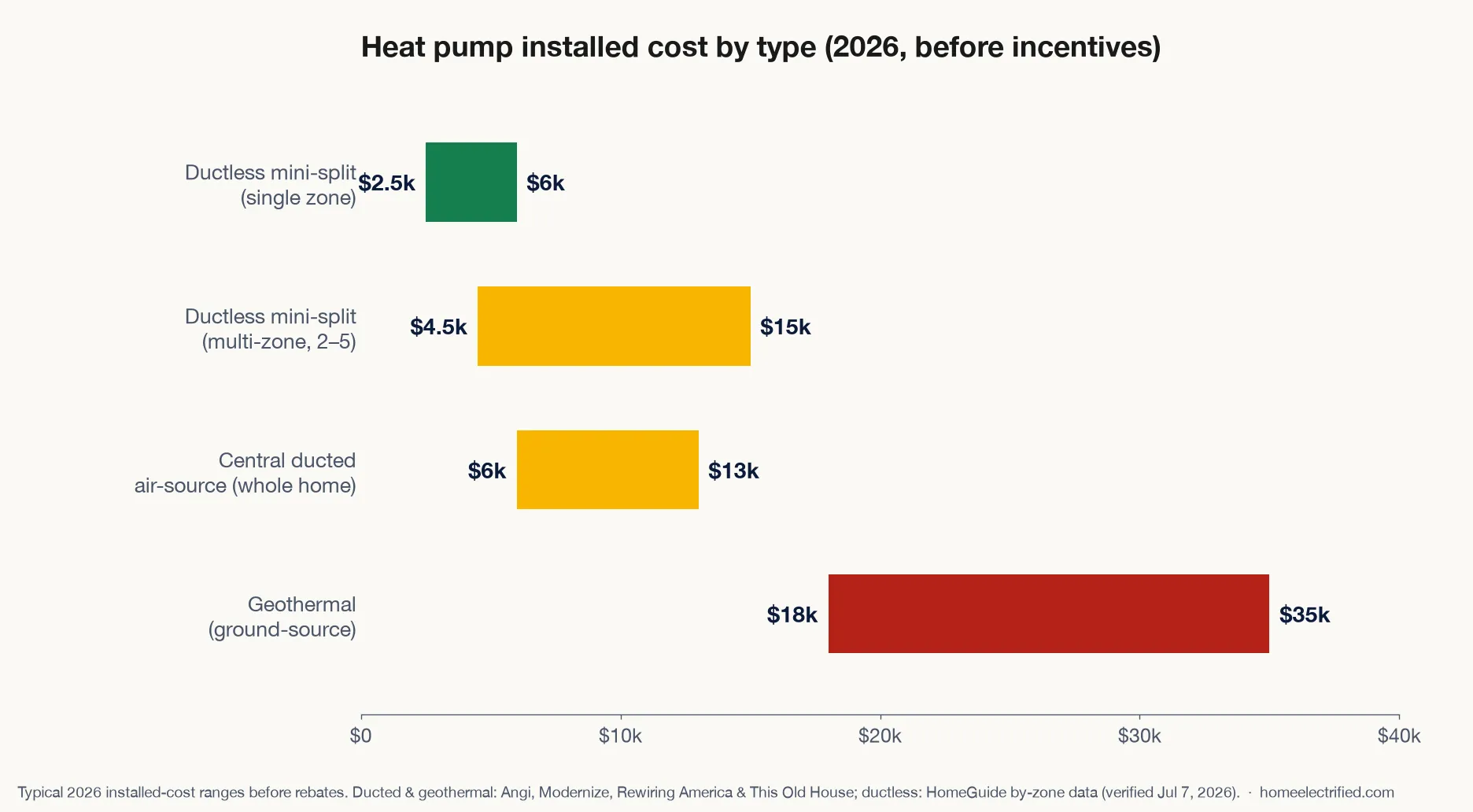
For most homeowners replacing a furnace and central AC, the central ducted air-source system is the relevant number — call it $6,000–$13,000, with a typical 3-ton system landing in the middle. The national average of ~$15,000 across all installs is pulled upward by expensive geothermal and large multi-zone jobs.
What drives the price
Five things move a heat pump quote the most:
- Type (above). Ductless vs. ducted vs. geothermal is the biggest swing by far.
- Size (tons). Capacity is measured in tons — a bigger home needs more. Cost scales roughly with tonnage. The right size comes from a Manual J load calculation, not a rule of thumb; an oversized system costs more and runs worse.
- Ductwork. If you have good existing ducts, a ducted system drops in. If ducts are missing, leaky, or undersized, you’re either paying to fix them or going ductless.
- Cold-climate capability. Modern cold-climate heat pumps that hold capacity below freezing cost more upfront but are what make a heat pump viable in northern states.
- Zones (ductless). Each indoor head in a mini-split system adds cost — figure roughly $2,000–$4,000 per added zone. For zone-by-zone and BTU-size pricing, see the full ductless mini-split cost breakdown.
⚠️ The federal heat pump tax credits expired — both of them
This is the big 2026 change, and many sites haven’t caught up. Under the One Big Beautiful Bill Act:
- The Section 25C credit for air-source heat pumps (up to $2,000) expired for systems placed in service after December 31, 2025.
- The Section 25D credit for geothermal heat pumps (30% of cost) also expired after December 31, 2025 — despite older guides that still claim it runs through 2032. We confirmed the expiration directly against ENERGY STAR and Rewiring America.
Only systems installed and operational by December 31, 2025 qualify (claim on IRS Form 5695 with your 2025 return). For 2026 installs, the federal tax credit path is closed.
What still lowers the cost in 2026
- IRA-funded state rebates (HEAR / HOMES). These are separate from the expired tax credits and survived. HEAR (for income-qualified households) can cover up to $8,000 toward a heat pump; HOMES rewards whole-home energy savings. They roll out state by state, so availability depends on your state’s program status.
- State and utility rebates. Many utilities offer their own heat pump rebates that stack with the above.
- How to find yours: search the DSIRE database (dsireusa.org) by ZIP code and check your utility’s website — the same approach that works for any electrification incentive.
Is a heat pump worth it?
The upfront cost is higher than a like-for-like furnace, but a heat pump replaces both your heater and your air conditioner with one system, and it’s 2–4× more efficient than resistance heating. Whether it pays off depends on what you’re replacing, your climate, and your local electricity vs. gas prices — which is exactly the running-cost comparison we’re building a calculator for next. (Short version: strongest case is replacing electric resistance, oil, or propane heat, or an aging AC that needs replacing anyway.)
Methodology & sources
Verified July 6, 2026; ductless figures re-verified July 7, 2026:
- Installed cost ranges: ducted and geothermal ranges cross-referenced from 2026 cost guides at Angi, Modernize, Rewiring America, and This Old House. Air-source ducted whole-home $6,000–$13,000 (3-ton systems commonly $5,800–$13,000); geothermal $18,000–$35,000 (average ~$28,000). National all-type average ~$15,000 before incentives. Ductless figures use HomeGuide’s 2026 by-zone installed-cost data — single-zone $2,500–$6,000; multi-zone $4,500–$15,000 (2–5 zones, ~$2,000–$4,000 per added zone) — the same dataset behind our dedicated mini-split cost page, so the two pages always agree.
- Federal credit expiration: Section 25C and 25D both ended for systems placed in service after December 31, 2025 (One Big Beautiful Bill Act), confirmed against ENERGY STAR’s geothermal tax-credit page (“before January 1, 2026”) and Rewiring America. Earlier third-party claims that 25D geothermal continues to 2032 are outdated.
- 2026 rebate pathways: IRA HEAR/HOMES programs (state-administered; HEAR up to $8,000 for income-qualified heat pump installs) plus state/utility rebates; use DSIRE to find local programs.
- Figures are planning estimates; get itemized local quotes, and insist on a Manual J sizing calculation.
Costs and incentive programs change; this page is re-verified on a schedule and the “verified” date reflects the latest check.
Frequently asked questions
How much does a heat pump cost to install in 2026?
It depends on the type. A whole-home central ducted air-source heat pump typically runs $6,000–$13,000 installed; a single-zone ductless mini-split $2,500–$6,000; a multi-zone ductless system $4,500–$15,000 depending on zones (two zones about $4,500–$8,000, five about $10,000–$15,000); and a geothermal (ground-source) system $18,000–$35,000. The national average across all types is roughly $15,000 before incentives.
What is the cheapest type of heat pump?
A single-zone ductless mini-split is the cheapest way in, at about $2,500–$6,000 installed — good for heating and cooling one room or a small space. Whole-home ducted air-source systems cost more but replace a furnace and AC for the entire house.
Is there still a federal tax credit for heat pumps in 2026?
No. Both the Section 25C air-source heat pump credit (up to $2,000) and the Section 25D geothermal credit (30%) expired for systems placed in service after December 31, 2025, under the One Big Beautiful Bill Act. Systems installed by that date can still be claimed. State and utility rebates — including IRA-funded HEAR/HOMES programs — remain the 2026 path.
Why is a geothermal heat pump so much more expensive?
Geothermal systems require burying a ground loop — drilling wells or excavating trenches to run pipe underground — which is major earthwork. That ground loop is most of the $18,000–$35,000 cost. In exchange, geothermal is the most efficient and longest-lasting type.
What size heat pump do I need, and how does it affect cost?
Heat pumps are sized in 'tons' of capacity (heating/cooling output, not weight). A typical home needs 2–5 tons, and cost scales with size — a 3-ton ducted air-source system commonly runs $6,000–$13,000. A proper Manual J load calculation by the installer, not square footage alone, determines the right size.