Quick answer: Charging a Tesla Model 3 RWD at home costs about $4.43 per 100 miles at the August 2026 U.S. average electricity rate (18.44¢/kWh) — roughly 4.4¢ per mile, or about $50 a month for a typical driver. A Model Y runs about $52–$56/month. Bigger EVs cost more per mile: a Rivian R1S is about $83/month and a Ford F-150 Lightning about $98/month. In every case, home charging is two to three times cheaper than a Supercharger or DC fast charger.
Last verified: August 2, 2026. Efficiency is EPA combined kWh/100 mi (fueleconomy.gov); electricity rate is the EIA U.S. average (May 2026 data). Sources in the methodology section.
Cost to charge popular EVs at home (2026)
Every figure below uses the vehicle’s EPA combined kWh/100 mi — the official rating, measured at the wall, so charging losses are already baked in — multiplied by the U.S. average residential rate of 18.44¢/kWh. “Per year” and “per month” assume 13,500 miles a year, the average U.S. driver.
| Vehicle | EPA kWh/100 mi | Cost per 100 miles | Cost per mile | Per year | Per month |
|---|---|---|---|---|---|
| Tesla Model 3 RWD | 24 | $4.43 | 4.4¢ | $597 | $50 |
| Tesla Model Y RWD | 25 | $4.61 | 4.6¢ | $622 | $52 |
| Tesla Model 3 Long Range AWD | 26 | $4.79 | 4.8¢ | $647 | $54 |
| Tesla Model Y Long Range AWD | 27 | $4.98 | 5.0¢ | $672 | $56 |
| Hyundai Ioniq 5 RWD | 30 | $5.53 | 5.5¢ | $747 | $62 |
| Ford Mustang Mach-E | 31 | $5.72 | 5.7¢ | $772 | $64 |
| Chevrolet Equinox EV | 31 | $5.72 | 5.7¢ | $772 | $64 |
| Rivian R1S | 40 | $7.38 | 7.4¢ | $996 | $83 |
| Ford F-150 Lightning | 47 | $8.67 | 8.7¢ | $1,170 | $98 |
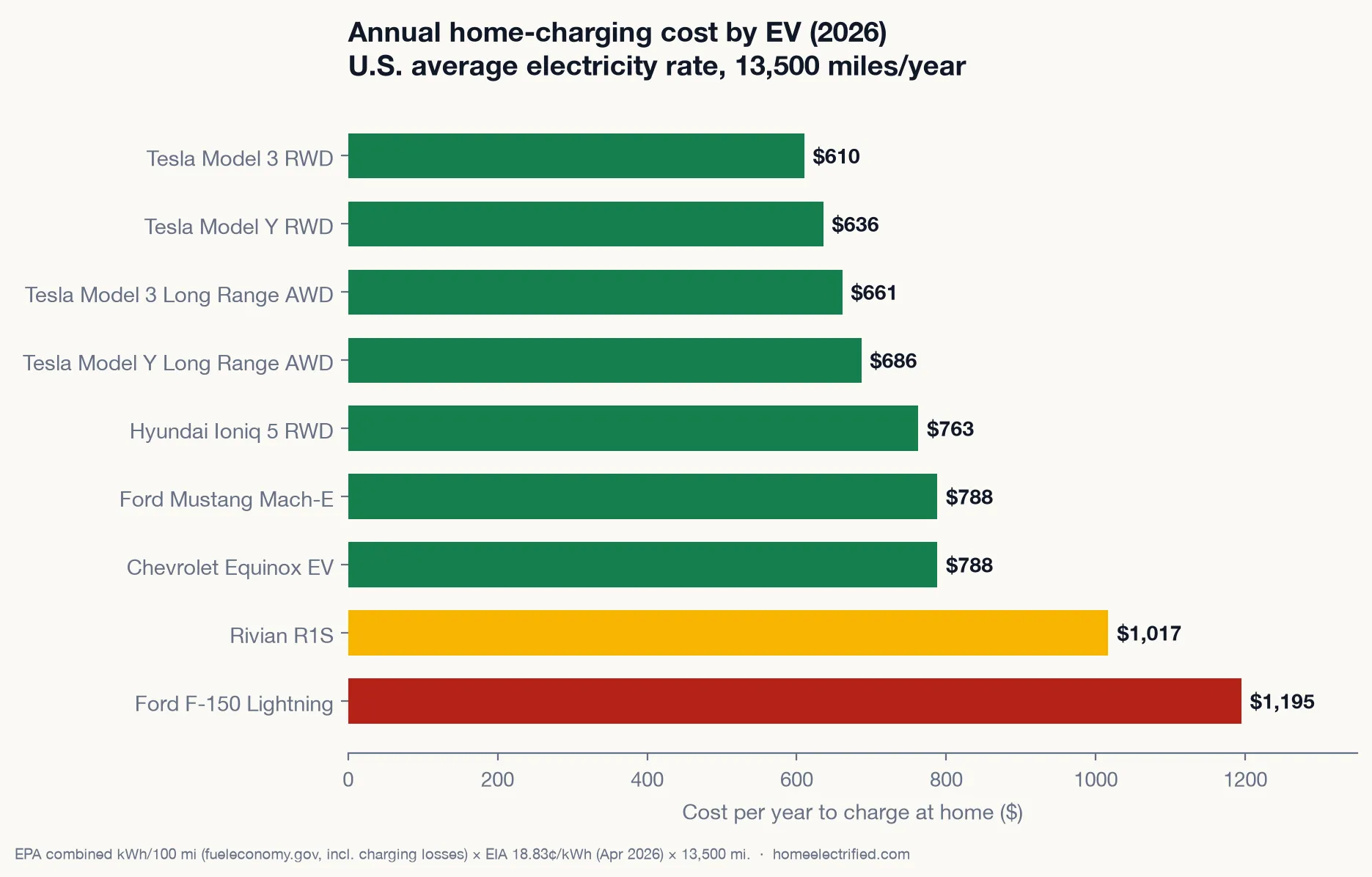
Why the numbers differ
Two things decide what a given EV costs to charge:
- Efficiency (kWh per 100 miles). This is the big one. A Tesla Model 3 sips 24 kWh/100 mi; an F-150 Lightning drinks 47 — nearly double — so the truck costs roughly twice as much per mile even on the identical electricity. Aerodynamic sedans beat heavy trucks and boxy SUVs every time.
- Your electricity rate. The table uses the 18.44¢/kWh national average, but rates run from about 12¢ (North Dakota) to 47¢ (Hawaii). To see your exact cost, plug your state and your car into the EV charging cost calculator.
Home vs. Supercharger vs. public DC fast charging
Where you plug in matters as much as what you drive:
- Home (Level 1 or Level 2): cheapest, ~19¢/kWh on average. This is 80–90% of most owners’ charging.
- Tesla Supercharger / DC fast charging: typically 40–60¢/kWh — two to three times home cost. Convenient on road trips, expensive as a daily habit. A Model 3 that costs ~4.5¢/mile at home can cost 11–15¢/mile on a Supercharger — close to gas.
- Free workplace or public Level 2: occasionally free; worth using when available.
The rule: charge at home for daily driving, fast-charge only on trips. If you can’t charge at home, your real cost is much closer to the DC-fast numbers — run those before assuming an EV will save you money.
How this compares to gas
Even the thirstiest EV here beats gas. The F-150 Lightning at 8.7¢/mile still undercuts a 28-MPG gas car at ~14.6¢/mile, and the efficient sedans cost a third as much. For the full breakdown — including all 50 states and annual savings — see how much it costs to charge an EV at home. And if you haven’t installed a home charger yet, check which EV charger rebates are still available in 2026 before you buy — the federal credit is gone, but some utility programs still cover the entire installation.
Methodology & sources
Verified August 2, 2026:
- Vehicle efficiency: EPA combined kWh/100 mi from fueleconomy.gov (2026 model-year listings; Model 3 RWD 24, Model Y RWD 25, Mach-E 31, Ioniq 5 RWD 30, Equinox EV FWD 31, Rivian R1S ~40, F-150 Lightning Extended Range ~47). EPA measures energy at the wall, so charging losses are included — no separate loss factor is applied here.
- Electricity rate: EIA U.S. average residential rate, 18.44¢/kWh (May 2026 data, latest state-level), retrieved August 2, 2026.
- DC fast / Supercharger range (40–60¢/kWh): typical 2026 public fast-charging pricing; varies widely by network, location, and time.
- Mileage: 13,500 miles/year (FHWA average driver).
- Figures are estimates for planning; your electricity plan (especially off-peak EV rates), driving style, and climate will move them.
Rates and EPA listings change; this page is re-verified on a schedule and the “verified” date reflects the latest check.
Frequently asked questions
How much does it cost to charge a Tesla Model 3 at home?
About $4.43 per 100 miles at the August 2026 U.S. average electricity rate (18.44¢/kWh) — roughly 4.4¢ per mile, or about $50 a month for a typical 13,500-mile-a-year driver. The Model 3 RWD uses 24 kWh per 100 miles by EPA rating.
How much does it cost to charge a Tesla Model Y at home?
About $4.61 per 100 miles for the Model Y RWD (25 kWh/100 mi), or roughly $52 a month at the U.S. average rate. The Long Range AWD costs a bit more, about $56 a month.
Is it cheaper to charge a Tesla at home or at a Supercharger?
Home is far cheaper. Home charging averages about 18¢/kWh; Superchargers and other DC fast chargers typically run 40–60¢/kWh — two to three times as much. Charge at home for daily driving and use Superchargers for road trips.
Which popular EV is cheapest to charge?
The Tesla Model 3 RWD is the cheapest of the popular models here at about $597/year, thanks to its 24 kWh/100 mi efficiency. Large electric trucks like the F-150 Lightning cost the most — about $1,170/year — because they use roughly twice the energy per mile.
Does the charging cost include charging losses?
Yes. These figures use EPA combined kWh/100 mi ratings, which the EPA measures at the wall outlet — so the 5–10% of energy lost during charging is already included. Your local electricity rate and driving style are the main reasons your cost may differ.