Quick answer: Often not. A 100-amp home can usually add a Level 2 charger, heat pump water heater and induction range: in our example they take it from 45 to 87 amps. A whole-home heat pump tips it, especially with backup heat. A $399–$786 load-management device can often replace a $1,300–$3,000 upgrade.
Last verified: October 31, 2026. Code rules from the 2023 and 2026 National Electrical Code (NFPA 70) as summarized by CK Electric and Sons, Intrysys and ECmag; adoption status from NFPA’s enforcement map; appliance ratings from Lawrence Berkeley National Laboratory; device prices from manufacturer and distributor pages; panel shares from NREL. Sources and dates in the methodology section.
The short version: it depends on a calculation, not on a rule of thumb
Whether your panel can take an EV charger or heat pump is not decided by the number on the main breaker alone, or by adding up every breaker in the box. It’s decided by a load calculation, a method in the National Electrical Code (NEC) that estimates how much your home can realistically draw at once. Your electrician does it; your inspector checks it.
Rewiring America’s guidance for homeowners is a good starting point:
| Your service | What it usually means |
|---|---|
| Under 100 amps (40 or 60 A) | You will likely need an upgrade to electrify |
| 100–150 amps | You can usually fully electrify without an upgrade, with some planning |
| More than 150 amps | You can usually electrify without an upgrade and without careful planning |
That is roughly a third of houses on the tight end. NREL’s national housing-stock research puts 30% of U.S. single-family homes on 100-amp panels and 49% on 200-amp panels. In the same preliminary modeling, 62% of homes would face panel constraints if they electrified the usual way, but 87% could keep their existing panel with envelope upgrades and lower-power, more efficient equipment.
To find your service size, look at the number on the main breaker at the top of your panel. If you have 200 amps, an EV charger and a heat pump almost never need an upgrade; the rest of this page is mostly for 100- and 150-amp homes.
How the code decides: two ways to check an existing home
Most states still enforce the 2023 NEC. NFPA’s enforcement map, as of August 3, 2026, showed the new 2026 edition in effect in only six states (Colorado, Maine, Massachusetts, Minnesota, North Dakota and Wyoming), with more adopting since. Under the 2023 code, an existing home has two optional methods:
1. Add up the loads (NEC 220.83). The electrician lists the home’s loads: 3 volt-amperes (VA) per square foot for lighting and outlets, 1,500 VA for each kitchen small-appliance circuit and the laundry circuit, plus the nameplate rating of every fixed appliance, such as a range, dryer, water heater or EV charger. Then:
- If you are not adding air conditioning or electric heat (part A), the first 8,000 VA counts at 100% and everything above it at 40%.
- If you are adding air conditioning or electric heat (part B), the larger of the heating or cooling load counts at 100%, and everything else gets the 8,000 VA at 100%, remainder at 40% treatment.
That 40% is why most new appliances fit, and the 100% for new heating or cooling is why a heat pump is the load that most often doesn’t. CK Electric and Sons, a contractor that publishes code summaries, warns that running a new heat pump through the 40% factor is a common mistake under the 2023 code.
2. Measure what the house actually uses (NEC 220.87). Instead of estimating, the electrician takes the home’s highest demand over the last year from utility meter data, multiplies it by 125%, and adds the new load at its full rating. If that total fits within the service rating, the new load is allowed. Where a year of data isn’t available, the code allows a recording meter for at least 30 days, using the highest 15-minute average while the home is occupied and the larger of the heating or cooling load is running, but not where the home has solar, wind or peak shaving. Smart meters make this method practical. Ask your utility whether it can provide interval or peak-demand data; many homes use far less than a paper calculation assumes.
An example of the metered method: if a year of data shows a peak of 6 kW, the code counts 6 × 1.25 = 7.5 kW, about 31 amps at 240 volts. A 100-amp service then has about 69 amps for new load at full rating, enough for a 48-amp charger on its own, which a 60-amp breaker supplies (11.5 kW is 48 amps).
The 2026 code changes the math
The 2026 NEC, issued August 20, 2025, moves load calculations to a new Article 120 (220.83 becomes 120.83, 220.87 becomes 120.87) and changes the existing-dwelling method. It counts lighting and outlets at 2 VA per square foot instead of 3, puts the first 8 kVA of existing and new load at 100%, the rest of the existing load at 40%, new EV chargers and new central electric resistance heat at 80%, and all other new loads, including a heat pump, at 50%, instead of 100% for new heating or cooling. The metered method now lets you subtract any load you remove, such as an old electric resistance furnace you’re replacing with a heat pump.
The net effect, by our reading: a heat pump or air conditioner calculates lower under 2026, while an EV charger can calculate higher than in 2023’s 40% remainder. If your state is on the 2026 edition, make sure your electrician uses it.
A worked example: electrifying a 100-amp home
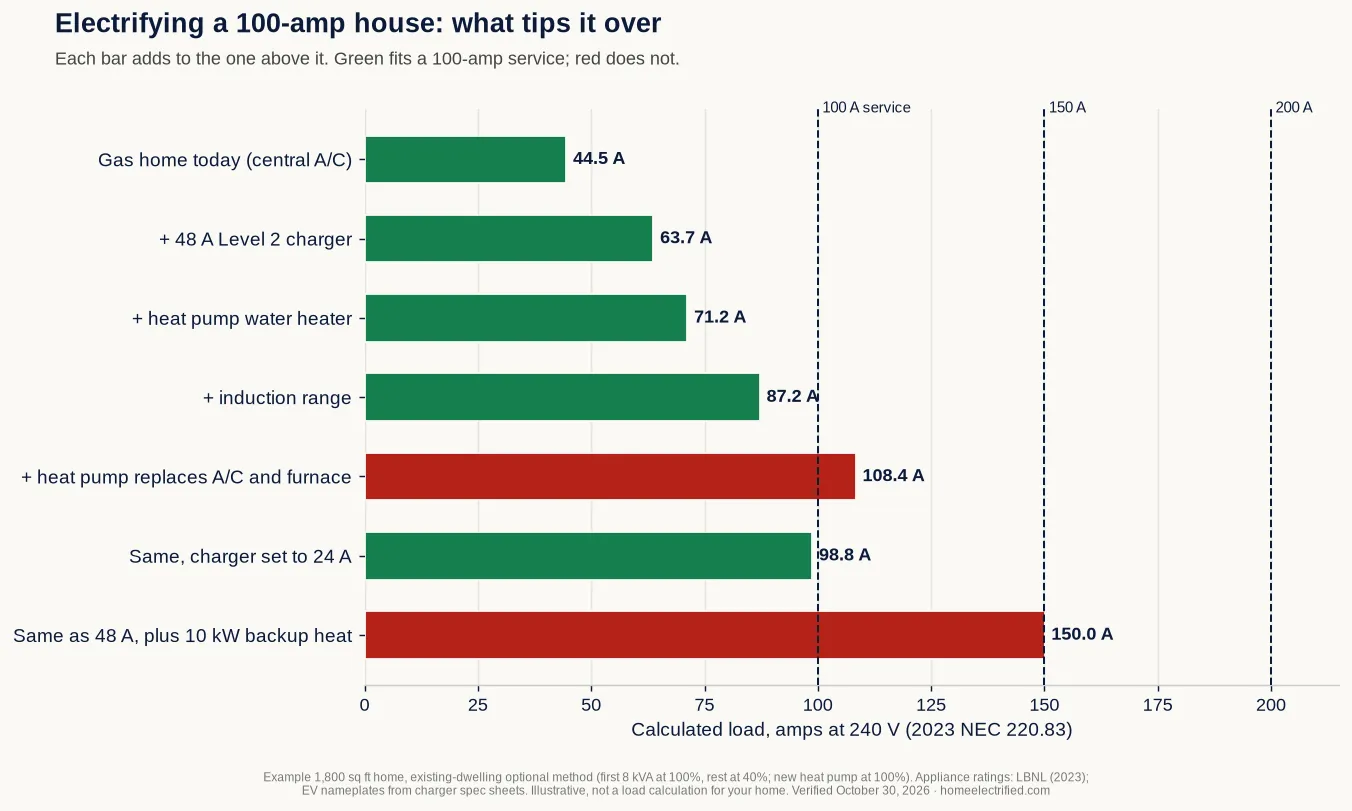
Here is the 2023 existing-dwelling calculation, done step by step for an example 1,800 sq ft home with 100-amp service, gas heat, a gas water heater and range, and a 3-ton central air conditioner. Each row adds to the one above it. Appliance ratings are the typical “efficient appliance” ratings Lawrence Berkeley National Laboratory (LBNL) uses in its panel-upgrade training; the EV charger figures are charger nameplates.
| Step | What’s added | Total loads (VA) | Calculated load | Fits 100 A? |
|---|---|---|---|---|
| Gas home today | Lighting 5,400 + 3 circuits 4,500 + 4,800 W central A/C | 14,700 | 44.5 A | Yes |
| + Level 2 charger | 48 A charger, 11,520 VA | 26,220 | 63.7 A | Yes |
| + Heat pump water heater | 4,500 W | 30,720 | 71.2 A | Yes |
| + Induction range | 9,600 W | 40,320 | 87.2 A | Yes |
| + Heat pump replaces A/C and furnace | 7,000 W heat pump at 100% (part B) | 35,520 + 7,000 | 108.4 A | No |
| Same, charger set to 24 A | 5,760 VA instead of 11,520 | 29,760 + 7,000 | 98.8 A | Yes, barely |
| Same as 48 A, plus backup heat | 10 kW electric strips, heating now 17,000 W | 35,520 + 17,000 | 150.0 A | No; at the limit of 150 A |
How a row is calculated, using the heat pump row: the non-HVAC loads total 5,400 + 4,500 + 11,520 + 4,500 + 9,600 = 35,520 VA. The first 8,000 counts in full and the remaining 27,520 at 40%, which is 11,008, for 19,008 VA. Add the heat pump at 100%: 19,008 + 7,000 = 26,008 VA. Divide by 240 volts: 108.4 amps, over a 100-amp service.
Four things the table shows:
- The EV charger, water heater and range fit. Even all three together leave this home at 87 amps, because under part A every load beyond the first 8,000 VA counts at 40%.
- The heat pump is the tipping point, because new heating or cooling counts at 100%.
- Charger speed matters. A charger set to 24 amps instead of 48 brings the fully electric home back under 100 amps. At 24 amps, a charger delivers 5.76 kW; at 3.5 miles per kWh and 10% charging losses, that’s about 18 miles of range per hour, or about 147 miles in an eight-hour night. The average U.S. driver covers about 37 miles a day (13,500 a year).
- Electric backup heat is the real budget-breaker. Adding 10 kW of resistance strips, common in cold climates, adds about 42 amps at 100%. That home needs a 200-amp service, or a cold-climate heat pump sized to run without big backup strips. See what size heat pump you need and whether a heat pump is worth it in a cold climate.
One caveat on the 24-amp row. In the standard calculation method, the 2023 code (220.57) counts an EV charger at 7,200 VA or its nameplate, whichever is larger. CK Electric notes that the existing-dwelling method doesn’t say, and advises asking your inspector. If your inspector applies the 7,200 VA floor, the 24-amp row comes to about 101 amps and fails by a hair. The 2026 code drops that floor. This is exactly why the decision belongs to a written load calculation, not a chart.
What each appliance draws
These ratings come from LBNL’s comparison of typical efficient appliances with “power-efficient” ones, plus the charger makers’ own specifications.
| Appliance | Typical rating | Lower-power option |
|---|---|---|
| Level 2 EV charger | 48 A = 11.5 kW on a 60 A breaker; 40 A = 9.6 kW on a 50 A breaker (Emporia) | Set it to 16–24 A, or share a circuit (below) |
| Heat pump, 2–4 ton | 18–29 A, 4,300–7,000 W | 120 V mini-split, 10.4 A, 1,090 W per head |
| Heat pump water heater | 4,500 W, usually a 240 V/30 A circuit | 120 V model, 8.3 A, 1,000 W |
| Induction range | 9,600 W | 120 V two-burner cooktop plus countertop oven, 1,200 W each |
| Electric dryer | 30 A, 7,200 W | 120 V heat pump washer-dryer combo, 10 A, 1,200 W |
Rewiring America adds that a 16-amp Level 2 charger still gives at least 100 miles a night, and a heat pump dryer can run on a 240 V/15 A circuit instead of the 30 A a resistance dryer needs. Ask your HVAC contractor for the unit’s minimum circuit ampacity before your electrician sizes anything.
Load management: the cheaper alternative to an upgrade
A load-management device watches either the whole house or one other appliance and pauses or turns down a big load, almost always the EV charger, when the total would exceed what the service can carry. The 2023 NEC lets an energy management system’s current setpoint be used in the load calculation (220.70 and 625.42), and the 2026 code formalizes it as a “power control system” whose setting can be no more than 80% of the circuit’s breaker rating (120.7). That is what makes these devices more than a workaround: done right, they pass inspection.
| Device | How it works | Price (checked Oct 30, 2026) |
|---|---|---|
| NeoCharge Smart Splitter | Plugs into an existing 240 V dryer outlet and shares it between the dryer and an EV; dryer gets priority. 24 A model for 30 A outlets, 40 A model for 50 A outlets | From $399, no electrician needed per the maker |
| Emporia Pro EV charger (PowerSmart) | Charger plus an in-panel energy monitor; turns charging down to stay within the panel’s capacity, up to 48 A | $599 for charger, monitor and software |
| simpleSwitch 240 | Hardwired; pauses a secondary load (EV) while a priority load runs, or when the whole home reaches 80% of capacity | $749 MSRP plus installation |
| RVE DCC-12 | Hardwired; cuts the charger when the panel exceeds 80% of the main breaker, restores it after 15 minutes below | $785.70 (100 A model, Platt Electric Supply) plus installation |
| SPAN smart panel | Replaces the panel; app control of each circuit; can pause EV charging when total load runs high | From $2,550 plus installation |
Two cheaper options don’t need a device at all. Most Level 2 chargers can be set to a lower current at installation, and Tesla’s Wall Connector, for example, can be set from 12 to 48 amps. And if you’re adding a 240 V appliance where an old one was, such as a heat pump water heater replacing an electric tank, you usually reuse the circuit and add no load at all.
What load management can’t fix: a heat pump. You can’t pause the heat on a cold night, so these devices are built around EV charging, dryers and water heating. If the heat pump is what tips your calculation, look at a smaller or 120 V unit, less backup heat, or the upgrade.
When you really do need the upgrade
- Your service is under 100 amps. Rewiring America says you’ll likely need an upgrade.
- The load calculation fails even with a lower-power plan, typically a whole-home heat pump with large electric backup heat on 100 or 150 amps.
- The panel itself is damaged or unsafe, which your electrician will flag. A panel can be replaced without increasing its amperage.
- You want everything at full speed: a 48-amp charger, a resistance-backup heat pump, a full-size dryer and range, with no lifestyle limits.
Running out of breaker slots is a space problem, not a capacity problem. A sub-panel ($500–$1,500) or tandem breakers usually solve it.
What the options cost
| Option | Typical cost | Source |
|---|---|---|
| New 240 V circuit on a panel with room | $60–$150 | EnergySage |
| Load-management device | $399–$786, plus installation for hardwired ones | Maker and distributor pages |
| Sub-panel | $500–$1,500 | EnergySage |
| Smart panel (SPAN) | From $2,550 plus installation | SPAN |
| 100-to-200-amp panel upgrade | $1,300–$3,000, about $2,150 on average | This Old House |
| Full service upgrade with new meter | $1,500–$4,000+ | EnergySage |
Rewiring America warns that if the utility has to replace the service drop or transformer, especially underground, costs can reach $5,000–$25,000, and the utility’s schedule can add months. Our electrical panel upgrade cost guide breaks down every line item, and shows that adding a $2,150 upgrade to a $1,700 charger install stretches its payback from about 16 months to 36 at U.S. averages.
Rebates: the federal 25C panel credit ended with 2025. The income-qualified HEAR rebate can pay up to $4,000 for a panel (“electric load service center”) and up to $2,500 for wiring, within a $14,000 cap, for households under 150% of area median income. States run it, and availability is patchy: California’s program is fully reserved, and Georgia’s reopened only for single-family wiring and panel upgrades tied to a Home Efficiency Rebates project (both checked October 30, 2026). Since September 1, 2026, new HEAR reservations can’t fund replacing gas, oil or propane equipment, so a panel upgrade done to switch from gas may not qualify; ask your state program. See which heat pump rebates survived in 2026 and which EV charger rebates are still open, several of which also pay for load-management devices.
How to get the right answer for your home
- List everything you plan to electrify in the next 10 years, not just this project. The calculation should include all of it.
- Get your peak-demand data from your utility if you can. It supports the metered method, which often shows more room than the paper method.
- Ask for the load calculation in writing, and which code edition and method it uses.
- Ask for a quote for a lower-power plan next to the upgrade quote: a lower charger setting, a load-management device, a 120 V water heater, a heat pump sized to need less backup heat.
- Do the electrical work once if you do upgrade, and size it for the whole list.
Then price the projects themselves: Level 2 charger installation cost, what it costs to charge an EV at home, heat pump cost and heat pump water heater cost.
Methodology & sources
All sources read October 30, 2026:
- 2023 NEC existing-dwelling method (220.83): CK Electric and Sons, “NEC 220.83: Adding new loads to an existing home’s service” (page last reviewed October 8, 2026): 3 VA per sq ft, 1,500 VA per small-appliance and laundry circuit, nameplate ratings of fixed appliances; first 8 kVA at 100% and remainder at 40%; added A/C or heat at 100%, larger of heating or cooling; 220.57 counts EVSE at 7,200 VA or nameplate, whichever is larger, in the standard method.
- Metered method (220.87): ECmag (NECA), “When a local requirement went national: Using optional calculations for determining existing loads” (May 14, 2024): one year of maximum-demand data or a 30-day recording meter with 15-minute averages, 125% of the peak plus the new load, 30-day option not allowed with solar, wind or peak shaving.
- 2026 NEC changes (Article 120, 120.7, 120.57, 120.83, 120.87): Intrysys, “NEC 2026 Changes: What Changed From NEC 2023”, read from both NFPA 70 editions by section and page; 2026 edition issued August 20, 2025.
- Code adoption: NFPA NEC enforcement maps (as of August 3, 2026): 2026 edition in 6 states (CO, ME, MA, MN, ND, WY). Intrysys’s tracker lists Texas (September 1, 2026), Arkansas and Oregon (October 1, 2026) since, and Washington from December 31, 2026, so check your own state.
- Panel sizes in U.S. homes: NREL/LBNL, “Low power electrification solutions enable affordable residential electrification by minimizing panel upsizing” (DOE Building Technologies Office peer review poster, October 2024; results marked preliminary): 30% of single-family homes on 100 A, 49% on 200 A; 62% face constraints under business-as-usual electrification; 87% can keep their panels with envelope and lower-power equipment.
- Appliance ratings: LBNL, “Avoiding Electric Panel and Service Upgrades in Home Decarbonization” (January 2023): electric dryer 30 A/7,200 W; heat pump water heater 19 A/4,500 W; 2–4 ton split heat pump 18–29 A/4,300–7,000 W; range 9,600 W; 120 V alternatives as listed. The 4,800 W 3-ton central A/C is EnergySage’s figure, already used on our home battery cost page.
- Panel guidance and pre-wiring: Rewiring America, Pros and cons of a panel upgrade (under 100 A likely upgrade; 100–150 A usually no upgrade with planning; over 150 A usually no planning; upgrade typically $2,000–$4,000, $5,000–$25,000 with service or transformer work), How to electrify on a 100 Amp panel (16 A charger at least 100 miles a night; heat pump dryer 240 V/15 A; heat pump water heater 240 V/30 A or 120 V options).
- Device prices and specs: NeoCharge Smart Splitter (from $399; 24 A/5.7 kW and 40 A/9.6 kW models); Emporia Pro EV Charger ($599 with Vue 3 monitor and PowerSmart; 48 A/11.5 kW on a 60 A breaker, 40 A/9.6 kW on a 50 A breaker); simpleSwitch ($749 suggested MSRP plus installation; UL 916 listed); RVE DCC-12 at Platt Electric Supply ($785.70, 100 A model) and RVE’s DCC-12 page for how it works (80% threshold, 15-minute restore); SPAN Panel (from $2,550 plus installation, taxes and shipping). Tesla Wall Connector’s 12–48 A adjustable range is from PG&E’s EV charging rebate page, read October 2026.
- Cost of options and HEAR: the figures registered on our electrical panel upgrade cost page (This Old House, Angi, EnergySage, ENERGY STAR HEAR page, DOE Program Notice 26-2). California and Georgia HEAR status re-checked October 30, 2026 for our heat pump rebates page.
- Worked example and charging math: ours. Calculated load in amps = calculated VA ÷ 240 V. Range per hour = 5.76 kW ÷ 1.10 losses × 3.5 mi/kWh. The 13,500 miles a year is the assumption used across this site.
- What we did not do: we did not inspect, calculate or upgrade anyone’s panel, and we did not test any of these devices. The worked example is an illustration of the code method on a made-up house, not a load calculation for yours, and the prices are planning figures, not quotes. Your electrician’s calculation, your adopted code edition and your inspector decide.
Codes, prices and rebate programs change; this page is re-verified on a schedule and the “verified” date reflects the latest check.
Frequently asked questions
Do I need a panel upgrade for a Level 2 EV charger?
Usually not if you have 100 amps or more. In our worked example, a typical 1,800 sq ft gas-heated home with central air calculates at about 45 amps under the National Electrical Code's existing-dwelling method, and adding a 48-amp charger takes it to about 64 amps. An electrician's load calculation for your own home decides it.
Can a 100-amp panel handle a heat pump?
Often, but a whole-home heat pump is the load most likely to push a 100-amp home over, because the code counts new heating or cooling at 100% instead of 40%. In our example, a fully electrified home with a 48-amp charger came to about 108 amps; turning the charger down to 24 amps brought it to about 99. Electric resistance backup heat pushes it much higher: 10 kW of backup strips took the same home to about 150 amps.
How do I know if my panel has room?
Ask an electrician for a load calculation in writing. The National Electrical Code allows two ways for an existing home: add up the home's loads with demand factors (220.83 in the 2023 code), or use a year of utility peak-demand data, multiply the peak by 125% and add the new load (220.87). Running out of breaker slots is a different problem and can often be solved with a sub-panel.
What is a load-management device and what does it cost?
A device that pauses or turns down a big load, usually an EV charger, when the rest of the house is drawing a lot, so the total stays within the service. Prices we checked on October 30, 2026: the plug-in NeoCharge Smart Splitter from $399, the Emporia Pro charger with built-in load balancing $599, the hardwired simpleSwitch $749 plus installation, the RVE DCC-12 $785.70 at a U.S. electrical distributor, and a SPAN smart panel from $2,550 plus installation.
Will a rebate pay for a panel upgrade?
The federal 25C panel credit ended with 2025. The income-qualified HEAR rebate can pay up to $4,000 for a panel, but states run it and many are closed or limited: California's is fully reserved, and Georgia's reopened only for single-family wiring and panel work tied to a Home Efficiency Rebates project (both checked October 30, 2026).